Skip to content

About Us

A non-profit foundation that puts people, their dignity and their right to a safe, healthy life at the heart of its work

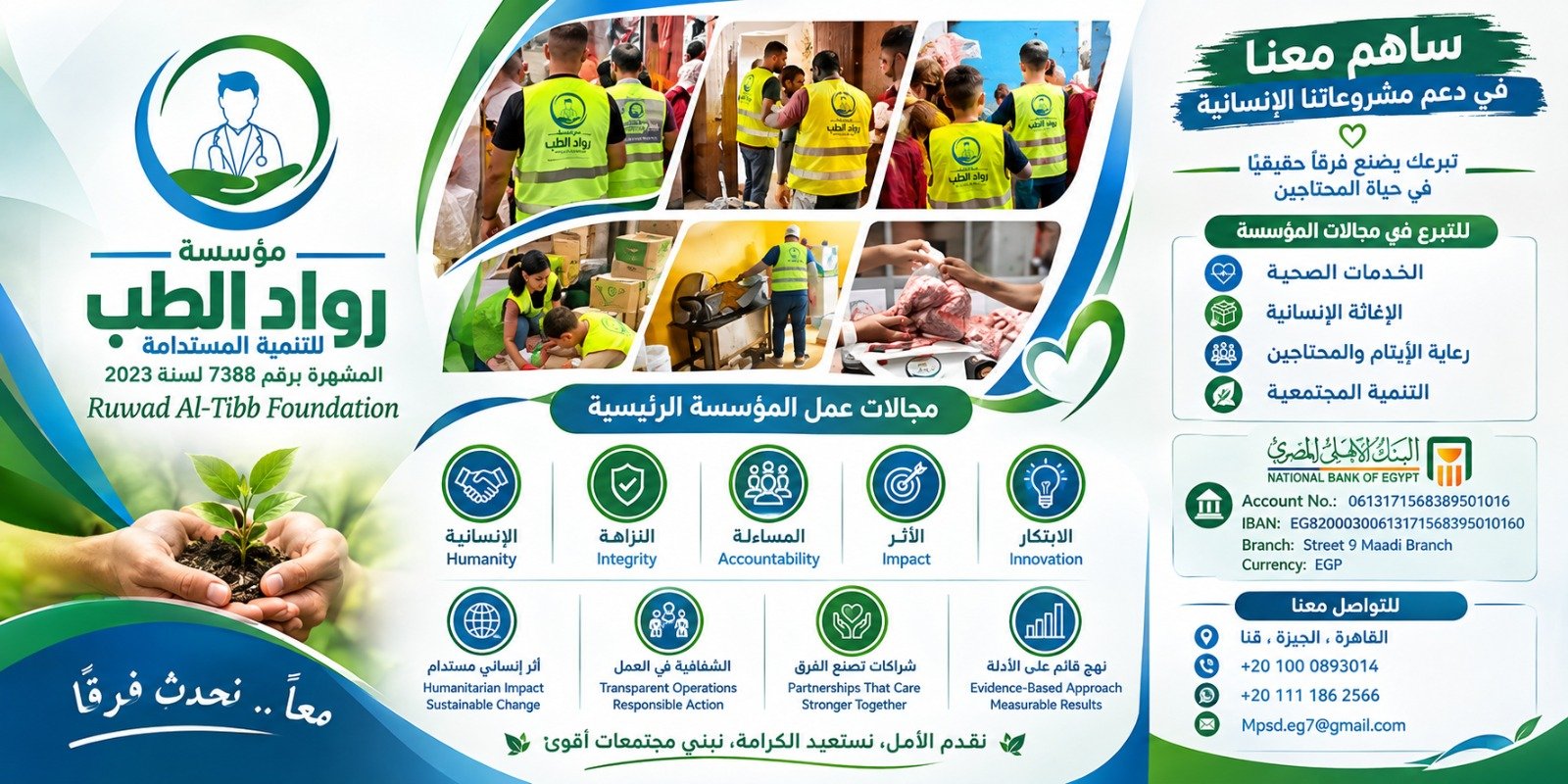
Rowad Al-Tibb Foundation for Sustainable Development is a non-profit civil society foundation working in health, community development and humanitarian response, putting people, their dignity and their right to a safe and healthy life at the heart of everything it does. It began its humanitarian work in 2014 and was officially registered in 2023 under the supervision of the Ministry of Social Solidarity.

The foundation grew from the conviction that access to basic services — above all healthcare — is the starting point for improving the lives of the families and communities most in need. As its experience grew, its work expanded from medical services to integrated programs in relief, food security, shelter, economic empowerment, education, social protection and community development.

The foundation combines responding to urgent needs with development solutions that build stability and self-reliance, focusing on the families most in need, underserved communities, and people affected by crises and displacement. It relies on a network of specialists, volunteers and partners from civil society, medical and humanitarian organizations.

The foundation does not see beneficiaries simply as recipients of aid, but as partners in a journey of change: health support restores the ability to live, social support strengthens stability, economic empowerment builds the capacity to produce, and education opens doors to the future. That is why Rowad Al-Tibb is building an integrated development model that brings together humanity, responsiveness, professionalism and sustainability.

From responding to need to creating impact

The Rowad Al-Tibb story began in 2014 with humanitarian work responding to the health and social needs of the most vulnerable. As field experience grew, the foundation realized that families' challenges are connected: health is tied to economic ability, family stability to food and a safe home, and empowerment to education and job opportunities.

So the work gradually evolved from direct medical services into a broader model. Along the way the foundation has run medical convoys, treatment and surgical interventions, and programs supporting people with disabilities and the injured, alongside relief, food security and shelter initiatives, support for refugees and displaced people, and economic empowerment, education and orphan care projects.

Today it aims to turn that experience from running initiatives into building development programs that are scalable, sustainable and measurable.

Milestones

  1. 2014

    The beginning

    The start of our humanitarian and community work.

  2. 2014 – 2022

    Growing field experience

    Expanding field experience in health services and humanitarian initiatives, and reaching the communities most in need.

  3. 2023

    Official registration

    Official registration of the foundation under No. 7388, supervised by the Ministry of Social Solidarity.

  4. 2023 – 2025

    Programs expand

    Programs expand to cover health, relief, food security, shelter, economic empowerment, education, and support for refugees and displaced people.

  5. Next phase

    Towards deeper impact

    Strengthening development programs and strategic partnerships, widening our reach, and building our capacity to measure impact and achieve sustainability.

How we evolved: from medical care to integrated development

  1. 1 Health
  2. 2 Social protection
  3. 3 Humanitarian response
  4. 4 Food security
  5. 5 Shelter
  6. 6 Empowerment
  7. 7 Community development

Our vision

To be a leading development and humanitarian foundation creating lasting impact in the lives of the most vulnerable, through an integrated model combining healthcare, humanitarian response, social protection, economic empowerment and community development — and to help build healthier, safer and more resilient communities where people are truly at the center of development.

Our mission

We improve the quality of life of the people most in need by designing and delivering health, humanitarian and development programs that respond to communities' real needs and combine urgent support with sustainable solutions, drawing on specialist expertise, volunteering and effective partnerships to achieve measurable, scalable impact.

We are committed to reaching those most in need, providing services with quality and dignity, and helping individuals and families overcome crises and build a more stable, independent future.

Our slogan

Human health.. the foundation of development

We believe a person's health is the cornerstone of a family's stability and its ability to learn, work and produce — and that healthcare alone is not enough. So we connect it with social support, food security, shelter, education and economic empowerment.

From humanitarian response.. to lasting impact

It reflects our journey from meeting urgent needs to developing solutions that build capability and independence and create long-term impact.

Our values

What guides how we work with beneficiaries, partners and donors.

  • Humanity & Dignity

    We put people, their dignity and their basic rights first, and provide support in a way that protects beneficiaries' privacy and dignity.

  • Justice & Equality

    We narrow gaps in access to basic services; everyone has the right to help once their case is verified, without discrimination by religion, race or gender.

  • Impact & Sustainability

    We measure success not by the volume of activity, but by its ability to create real and lasting change in beneficiaries' lives.

  • Professionalism & Quality

    We design our programs around clear needs and specialist expertise, and deliver our services in an organized, institutional way that meets material, emotional, educational and health needs.

  • Transparency & Credibility

    We are committed to the responsible use of resources, spending donors' money where it is meant to go, and continuously following up and measuring results and impact.

  • Responsiveness & Agility

    We respond quickly and flexibly to changing needs and humanitarian crises, while keeping our interventions effective and of high quality.

  • Continuity

    We provide ongoing support to those who need it, giving them security in the face of life's basic challenges.

  • Commitment

    We never promise what we cannot deliver, and we keep our commitments in full with everyone we work with.

  • Volunteering & Social Responsibility

    We believe in the power of community participation and put volunteers' energy and professional expertise to work for those most in need.

  • Partnership

    We build effective partnerships with donors, government and civil institutions, the private sector and international bodies — because today's challenges demand combined effort.

Our strategic goals

12 connected goals that put people at the heart of development.

  1. 01

    Improve access to healthcare

    Narrow health gaps by providing medical, curative and preventive services, including medical convoys, specialized services, and surgical and rehabilitation interventions.

  2. 02

    Respond to humanitarian needs and emergencies

    Fast, effective interventions for people affected by crises, disasters and displacement, with health, food, social and psychological support.

  3. 03

    Strengthen food security and social protection

    Provide food and basic needs for the most vulnerable families and reduce the effects of poverty and crises.

  4. 04

    Provide a safe, dignified living environment

    Improve housing, provide shelter when needed, and promote safety and human dignity.

  5. 05

    Empower women and people able to work

    Move from direct support to empowerment through small businesses, sources of income and training.

  6. 06

    Protect children and the right to education

    Reduce school dropout, support children and orphans, and provide school supplies.

  7. 07

    Promote the inclusion of people with disabilities and the injured

    Provide prosthetic devices, artificial limbs, rehabilitation and psychosocial support.

  8. 08

    Promote women's health and prevention

    Raise health awareness among women and support prevention and early screening.

  9. 09

    Support the communities most in need

    Reach villages and underserved areas with interventions based on real need.

  10. 10

    Build sustainable development partnerships

    Strategic partnerships with donors, international institutions, the private sector, government and civil society to mobilize resources and maximize impact.

  11. 11

    Promote volunteering and social responsibility

    Mobilize community energy, encourage volunteering and strengthen a culture of solidarity.

  12. 12

    Develop measurable, scalable programs

    Move from short-term initiatives to programs built on needs assessment, performance indicators and impact measurement.

Impact partners

The foundation builds partnerships with everyone able to contribute to lasting impact: civil society organizations and local associations, medical bodies and health workers, the private sector and CSR programs, government and local authorities, humanitarian and development organizations, international bodies, and volunteers, experts and specialists.

It seeks long-term partnerships with donors, international institutions and the private sector to design multi-year programs that are measurable, scalable and responsive to the real needs of target communities.

Resources + Expertise + Partnership + Fieldwork = Greater impact

  • Ministry of Social Solidarity
  • Egyptian Red Crescent
  • Misr El Kheir Foundation
  • Mersal Foundation
  • Egyptian Cure Bank
  • Human Help Austria
  • Hayrat Yardım
  • Relief & Emergency Foundation
  • Regional Union of NGOs in Giza
  • Forsan
  • YFCC

Contributing to the Sustainable Development Goals

  • 1

    No Poverty

    Supporting the families most in need through sponsorship, cash and in-kind aid, and economic empowerment.

  • 2

    Zero Hunger

    Daily meals, food baskets, Udhiyah projects and regional food response.

  • 3

    Good Health and Well-being

    Improving access to health services and strengthening prevention and healthcare.

  • 4

    Quality Education

    Reducing school dropout and supporting children and orphans with school supplies and care.

  • 5

    Gender Equality

    Supporting women's health, women heads of household and women's economic empowerment.

  • 8

    Decent Work and Economic Growth

    Turning skills into income through marketing and small businesses.

  • 10

    Reduced Inequalities

    Narrowing the gap in access to services between those who can afford them and those who cannot, and between regions.

  • 11

    Sustainable Cities and Communities

    Improving housing conditions and home safety in the neediest villages.

  • 13

    Climate Action

    Protecting families from harsh weather through roofing and winter campaigns.